
Lessons of 2026
Lesson No. Forty-Three
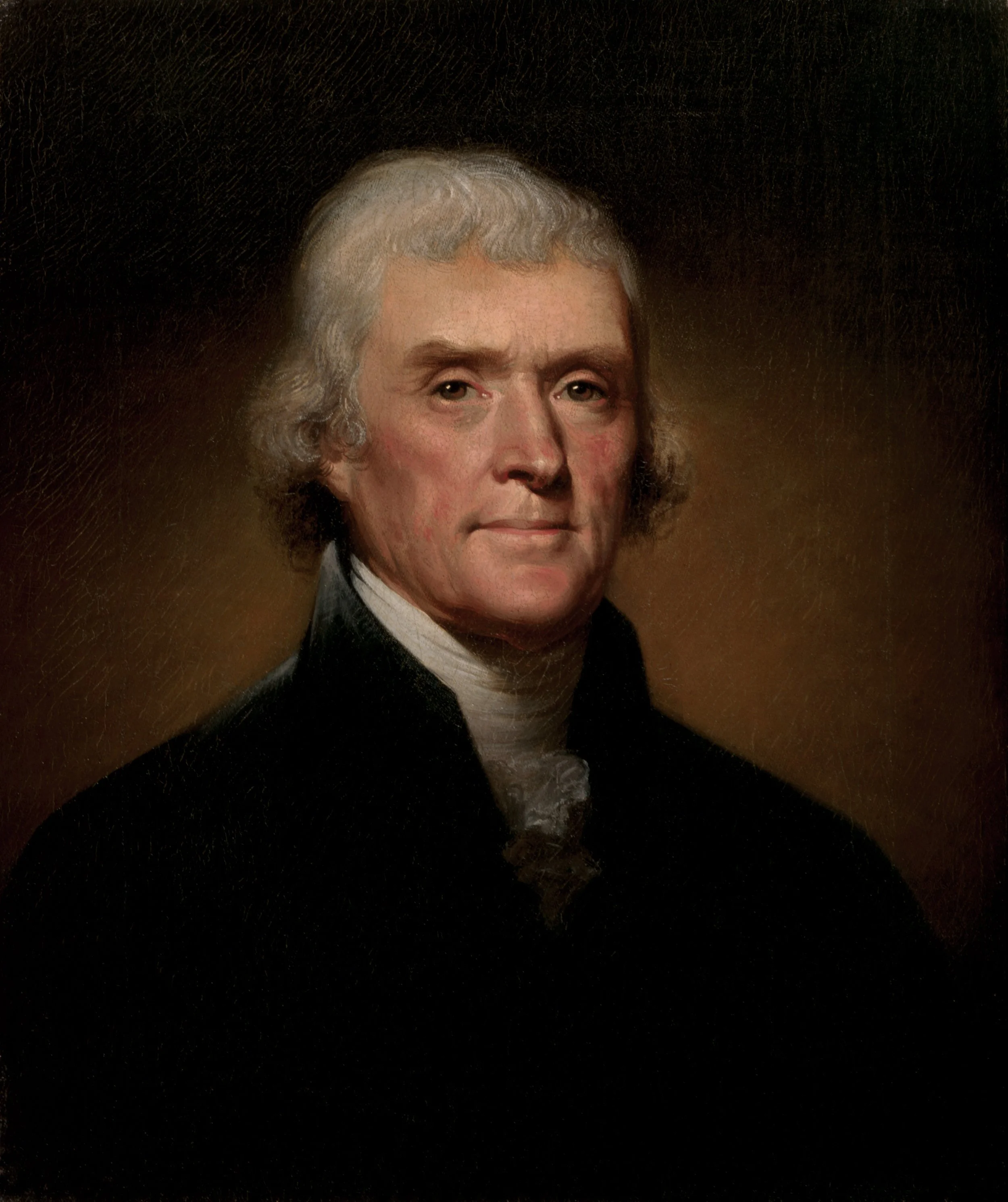
Official portrait painting of Thomas Jefferson. (Image sourced from wikipedia.org.)
Thomas Jefferson was the primary author of the Declaration of Independence, a document which inspires democracies around the world. For 250 years the Declaration of Independence has blessed our world. Jefferson explained: “We act not for ourselves but for the whole human race. The event of our experiment is to show whether man can be trusted with self – government.” He is also remembered for his advocacy of religious freedom and tolerance.
Jefferson was a prolific reader and a true scholar. At age 14 he could read Latin, Greek, French, Spanish, and Italian. He was a successful lawyer, and while studying law he took an incredibly intensive course on self-education. He studied languages, physics, agriculture, mathematics, philosophy, chemistry, anatomy, zoology, botany, religion, politics, history, literature, rhetoric and, and virtually every other subject imaginable.
As a youth, Jefferson practiced every day for an hour or more on the violin. He could also play the cello. As President of the United States he continued to sharpen his skills on the violin. “Music,” he wrote to a friend, “is the favorite passion of my soul.”
Jefferson treasured his books. In his youth he began assembling his first library, which grew to 200 volumes. In 1770 it was destroyed in a fire at his home. His second library grew to nearly 6,500 volumes and in 1814. Jefferson sold his second library to the U.S. government to be part of the Library of Congress. Jefferson soon resumed collecting his third personal library. By the time of Jefferson's death, his third and final library had grown to nearly 2,000 volumes.
Jefferson accomplished what may be the greatest diplomatic successes in history, the peaceful acquisition of the Louisiana Territory. The purchase of the Louisiana Territory from France for $15 million ($391 million in today’s dollar) doubled the size of our country, adding all or part of fifteen present-day states. The Louisiana purchase is considered by many historians to be the most formative event in American history.
Jefferson was an outdoors man who loved and studied nature. He helped train Merriwether Lewis, and Jefferson’s presidential support was critical to the success of the Lewis and Clark Expedition in exploring the Louisiana Territory.
We can learn much for the life of Thomas Jefferson, and one of the most important is his love for learning and reading. Unfortunately, many people today seem to have little interest in books, learning and education. Many people get most of their information from social media. This seems to be especially true among the rising generation, whose primary responsibility should be to educate their minds and/or their hands.
“Reading is to the brain what physical exercise is to the body. If you forsake it, you will eventually pay the consequences. Just as a body gets weaker when it remains inactive, the brain does as well. Instead of thinking through serious issues, it accepts weak arguments at face value, making it prey to falling to the prevailing winds of the time” (How to Avoid the New Dark Age, by Timothy Goeglein).
Reading is the gateway to opening the mind to knowledge. It is no coincidence that many of the great movements that shaped the world we live in occurred after Gutenberg invented the printing press, which sparked the mass production of printed books for the first time. It was reading that helped spark the American Revolution, as it allowed great thinkers, like Thomas Jefferson, to put pen to paper and have their thoughts, as in the Declaration of Independence, distributed and read widely” (ibid).
Learning and Education are essential in the Gospel of Jesus Christ. Examples follow:
D&C 88:118. And as all have not faith, seek ye diligently and teach one another words of wisdom; yea, seek ye out of the best books words of wisdom; seek learning, even by study and also by faith.
D&C 90:15. And set in order the churches, and study and learn, and become acquainted with all good books, and with languages, tongues, and people.
D&C 130:18. Whatever principle of intelligence we attain unto in this life, it will rise with us in the resurrection.
Thomas Jefferson and John Adams were friends in the beginning, then competitors, and then they reconciled. They served together in the Continental Congress. Adams was first to be considered by the Congress to write a Declaration of Independence. But he pushed for Jefferson to be given that assignment. Adams strongly supported what Jefferson wrote. In the 1780s they worked together, Adams as ambassador to England and Jefferson as ambassador to France. The Federalist/Republican split of the 1790s divided them. The two men did not communicate directly for more than a decade after Jefferson succeeded Adams as president.
Jefferson and Adams and the power of forgiveness. Mutual friends began to prod them to renew their friendship. In 1812, Adams wrote a short New Year's greeting to Jefferson to which Jefferson warmly responded. This initial correspondence began what has been called "one of the most extraordinary correspondences in history". Over the next 14 years, Jefferson and Adams exchanged 158 letters. They were brilliant and accomplished men who humbled themselves setting an example for us, and they found favor with the Lord.
John Adams and Thomas Jefferson both died on July 4, 1826 which was the Fiftieth Anniversary of the Declaration of Independence. Adam’s last words were an acknowledgment of his longtime friend and rival. He said, "Thomas Jefferson survives", unaware that Jefferson had died a few hours earlier. I believe that both Jefferson and Adams passing to the spirit world on the Fiftieth Anniversary of the signing of the Declaration of Independence was not a coincidence. I concur with what John Quincy Adams wrote, that it was a “visible and palpable manifestation of Divine Favor.”
Testimony. Jefferson loved books but the most important book in the world was not in his libraries. On March 30, 1830, almost four years after Jefferson and Adams died, 5,000 copies of The Book of Mormon were printed and made available to the world.
Thomas Jefferson was a lover of books, and doubtlessly, he has studied the Book of Mormon in the spirit world. Thomas Jefferson and John Adams were among the Founders who appeared to Wilford Woodruff in the St George Temple asking for their temple work to be done. (See Lessons on Freedom and Patriotism, Lesson 8)
I believe the most beneficial thing we can learn from the life of Thomas Jefferson is to love books, particularly The Book of Mormon. Great will be our blessings if we study and read from The Book of Mormon every day.
Released on November 25th. 2026.