
Lessons of 2026
Lesson No. Two
Adam and Eve and the Doctrines and Principles of the Plan of Salvation
The word “doctrine”, as applied to the gospel of Jesus Christ, means the truths of salvation. The doctrines of salvation are recorded in the scriptures and are taught by prophets and apostles.
The plan of salvation, as taught in the scriptures, by apostles and prophets, and in the temple, is founded on three fundamental doctrines - the creation, the fall, and the atonement of Jesus Christ. The Old Testament gives basic facts concerning the creation and the fall, but there are only vague references to the Savior and His atonement. Certainly the doctrine of the atonement of Jesus Christ is what was the most “plain and precious thing” taken from the scriptures as prophesied in 1 Nephi 13:21-42. In this Lesson I will use latter day scripture and prophets to teach the plan of salvation, and how the creation, the fall, and the atonement of Jesus Christ are inseparably woven together.
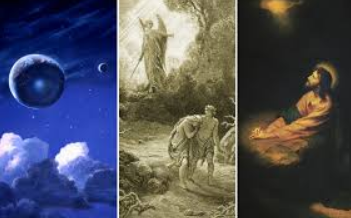
The Creation, Adam and Eve being cast out of the Garden of Eden, and Christ’s Atonement.
The Creation, the Fall, and the Atonement of Jesus Christ have been referred to as the three pillars of eternity: "God himself, the Father of us all, ordained and established a plan of salvation whereby his spirit children might advance and progress and become like him. It is the gospel of God, the plan of Eternal Elohim, the system that saves and exalts, and it consists of three things. These three are the very pillars of eternity itself. They are the most important events that ever have or will occur in all eternity. They are the Creation, the Fall, and the Atonement.
"Before we can even begin to understand [the plan of salvation] we must know how and in what manner these three eternal verities—the Creation, the Fall, and the Atonement—are inseparably woven together to form one plan of salvation. No one of them stands alone; each of them ties into the other two; and without a knowledge of all of them, it is not possible to know the truth about any one of them…. The Creation is the father of the Fall, and the Fall made possible the Atonement, and that salvation itself comes because of the Atonement….
“Thus, man is created in such a way that he can fall. He falls and brings mortality and procreation and death into being so that he can be redeemed by the atoning sacrifice of the Lord Jesus Christ. And he is ransomed from the temporal and spiritual death brought into the world by the Fall of Adam so that he can have immortality and eternal life. The Creation, the Fall, and the Atonement are bound together as one”(Bruce R. McConkie, Christ and the Creation, Ensign, June 1982, p. 9).
The Lord defined word “principles” as the “true points of my doctrine” (D&C 10:62), and He spoke of moral agency and accountability calling them “just and holy principles” (D&C 101:77-78). Moral agency and accountability are essential principles in the plan of salvation. Agency in general can refer to our ability to choose things like “where” we live. Moral agency is far more important and refers to our ability to choose “how” we live. It is our right and responsibility to choose between good and evil. The principle of accountability makes us responsible for our choices and the consequences that will inevitably follow. In the teachings of The Church of Jesus Christ of Latter-day Saints the words “agency” and “moral agency” are now used interchangeably.
The First Presidency taught the principles of agency and accountability with specificity and in plainness. When Nephi quoted the teachings of Isaiah in 2 Nephi 12-24 he made sure his people understood by explaining Isaiah’s teachings in plainness. (See 2 Nephi 25:1-7) Likewise, the First Presidency taught the youth of the Church the principles of agency and accountability by explaining, in plainness and specificity the teachings of 2 Nephi 2.
Nephi 2 is the most complete discussion in scripture of the just and holy principles of agency and accountability. 2 Nephi 2 should be studied closely, and then we should apply what the First Presidency teaches in the pamphlet entitled For the Strength of Youth, “Agency and Accountability” to our individual lives. This pamphlet is addressed to the youth but it applies to people everywhere. (All verses cited are from 2 Nephi 2) “Your Heavenly Father has given you agency (vs 16), the ability to choose right from wrong and to act for yourself (vs 16, 26). You have been given the Holy Ghost to help you know good from evil (vs 5, 18, 26). While you are here on earth, you are being proven to see if you will use your agency to show your love for God by keeping His commandments (vs 21).
“While you are free to choose for yourself, you are not free to choose the consequences of you actions (vs 26). When you make a choice, you will receive the consequences of that choice (vs 10). The consequences may not be immediate, but they will always follow, for good or bad. Wrong choices delay your progression and lead to heartache and misery. Right choices lead to happiness and eternal life. That is why it is so important for you to choose what is right throughout your life (vs 27-29).
“You are responsible for the choices you make. You should not blame your circumstances, your family, or your friends if you choose to disobey God’s commandments. You are a child of God with great strength. You have the ability to choose righteousness and happiness, no matter what your circumstances.
“You are also responsible for developing the abilities and talents Heavenly Father has given you. You are accountable to Him for what you do with your abilities and how you spend your time. Do not idle away your time. Be willing to work hard. Choose to do many good things of your own free will" (For the Strength of Youth, "Agency and Accountability").
Adam and Eve were taught the plan of salvation and they rejoiced. Many days elapsed after Adam and Eve left the Garden of Eden, and then an angel appeared to Adam and taught him of the atonement of Jesus Christ. (See Moses 5:6-9)
Adam was filled with the Holy Ghost, and he began to prophecy saying: “Blessed be the name of God, for because of my transgression my eyes are opened, and in this life I shall have joy, and again in the flesh I shall see God” (Moses 5:10).
When Eve learned of these things she believed, and her response was profound: “Were it not for our transgression we never should have had seed, and never should have known good and evil, and the joy of our redemption, and the eternal life which God giveth unto all the obedient” (Moses 5:11).
Then “Adam and Eve blessed the name of God, and they made all things known unto their sons and their daughters” (Moses 5:12).
Testimony. Adam and Eve set the example for all of their posterity. They understood the doctrines and principles of the plan of salvation and of the atonement of Jesus Christ. Importantly, they taught it all to their children, and then testified of the truthfulness of what they had taught. May we be wise and courageous enough to do the same.
Released on January 18th. 2026.