
Lessons of 2026
Lesson No. Twelve
A Sacred Ordinance, a Holy Anointing, and a Token
Holy Week began on Palm Sunday and concluded a week later on Easter Sunday when the Lord was resurrected. However, the sacred anointing that took place in Bethany on the Lord’s last Sabbath in mortality, the Saturday before Palm Sunday, is often overlooked. Furthermore, it may not be understood even by members of the Restored Church of Jesus Christ.
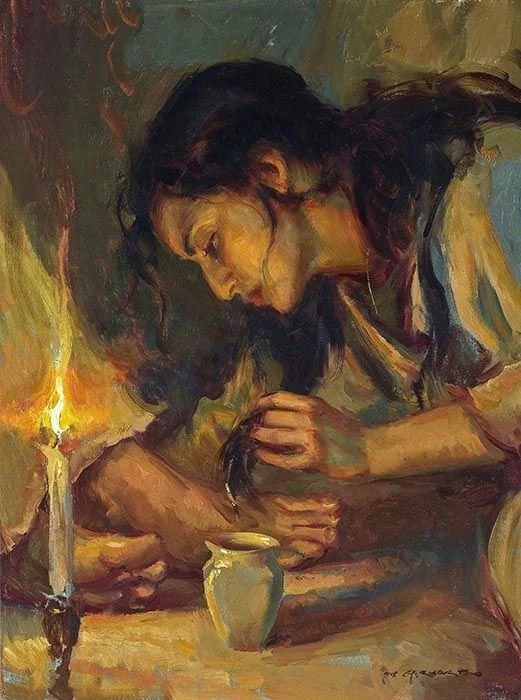
Mary anointing Jesus’s feet with oil and wiping them with her hair.
A sacred ordinance, a holy anointing, and a token. “Then took Mary a pound of ointment of spikenard, very costly, and anointed the feet of Jesus, and wiped his feet with her hair: and the house was filled with the odour of the ointment” (John 12:3). What Mary did was much more than an act showing great respect for a special guest. It was a sacred priesthood ordinance that Mary purposely made preparations for well in advance.
The Joseph Smith Translation of the Bible makes some revisions to these verses. The most important revision adds the word “token”, and states: “Then said Jesus, Let her alone: for she hath preserved this ointment until now, that she might anoint me in token of my burial” (JST John 12:7, emphasis added). Mary’s performing this ordinance must have been coordinated with Jesus in advance, and it was not a surprise to Him. Furthermore, those who are familiar with the temple have some understanding of the importance of anointings and tokens.
“Anoint” is defined as: “to consecrate or make sacred in a ceremony that includes the token applying of oil.” “Token” is defined as: “something serving to represent or indicate some fact, event, feeling, etc.” In this case it seems that Mary’s anointing of Jesus was a unique ordinance, which applied only to Him, showing that His death was consecrated and made sacred as a necessary step to the greatest miracle of all, the universal resurrection.
To understand the very special significance of Mary’s anointing of Jesus it is helpful to note the unique relationship Jesus had with Mary, Martha, and Lazarus. Elder Bruce R. McConkie wrote: “…we must note the intimate and felicitous friendships that prevailed between Jesus and the beloved sisters and their brother Lazarus. We have reason to believe this relationship was like none other enjoyed by him who came to do all things well and gain all the experiences of mortality. All scripturalists and authors of insight and renown are aware of the unique and unusual familial scenes portrayed by the Gospel authors with reference to the various happening in this secluded and peaceful village” (Bruce R. McConkie Mortal Messiah 3:333-339).
A close study of the events that took place in Bethany during Holy Week will better prepare us to celebrate the greatest events in the history of mankind. From the New Testament accounts we learn that Jesus spent Sunday, Monday, and Tuesday nights during the Holy Week in the home of Mary, and Martha. The New Testament records nothing about Jesus’ activities on Wednesday of Holy Week. He likely spent most, if not all, of Wednesday in Bethany at the home of Mary and Martha.
Elder Bruce R. McConkie wrote with inspired insight about “the holy anointing” and “the scared ordinance” and “the religious significance of Mary’s act”: “Jesus chose to spend a quiet Sabbath, his last on earth, in his beloved Bethany. There enjoying sociality with Mary and Martha and Lazarus and those of his intimate circle, he will receive the holy anointing preparatory to his kingly burial…
“But before recounting the circumstances surrounding the sacred ordinance, which will transpire in this Judean village of blessed memory…Mary sought some means of expressing her love and worship of the Master before he went to his death. She took from her treasures an alabaster box containing ‘a pound of ointment of spikenard, very costly,’ and poured it on his head, and anointed his feet, and wiped them with her hair ‘and the house was filled with the odour of the ointment’…
“To understand this solemn scene one must both know and feel the religious significance of Mary’s act. Here sat the Lord of heaven, in the house of his friends, as the hour of his greatest trials approached, with those who loved him knowing he was soon to face betrayal and crucifixion. What act of love, of devotion, of adoration, of worship, could a mere mortal perform for him who is eternal? Could a loved one do more than David had said the Good Shepherd himself would do in conferring honor and blessing upon another, that is ‘Thou anointest my head with oil” (Ibid, emphasis added).
Testimony – Elder McConkie finishes his six page description of Mary’s anointing of Jesus with a very interesting conclusion. “He that hath ears to hear, let him hear!” (Ibid, emphasis added). It seems that Elder McConkie is saying that some people have been taught and have experienced things that should give them a greater understanding of the religious significance of Mary’s anointing of Jesus on the last Sabbath of His mortal ministry.
I am so very grateful for the teachings of the temple that opens our ears to hear and our hearts to understand better the many sacred ordinances and covenants associated with the gospel of Jesus Christ.
Released on March 29th. 2026.