
Lessons of 2026
Lesson No. Twenty
Come Listen to a Prophet’s Voice
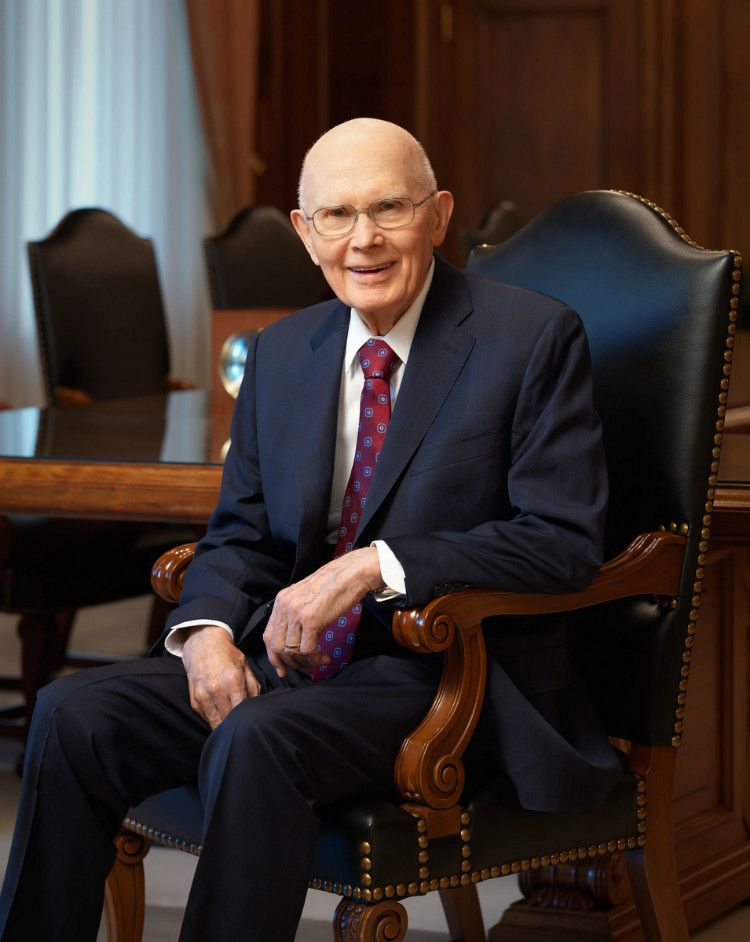
Official portrait of President Dallin H. Oaks. (Image sourced from churchofjesuschrist.org.)
Introduction. “Come listen to a prophet’s voice, And hear the word of God, And in the way of truth rejoice, And sing for joy aloud” (Hymns, p. 21). These words are the first stanzas of the first verse of Come Listen to a Prophet’s Voice (LDS Hymn Book, p. 21) written by Joseph F. Murdock who lived in the early day of the Church. Over 100 years later Elder Bruce R. McConkie added a fourth verse which begins with the words, “Then heed the words of truth and light That flow from fountains pure, Yea, keep his law with all thy might Till thine election’s sure.”
The words of this hymn reminds me of two personal experience I have had, first with then President Ezra Taft Benson, who was also Secretary of Agriculture in the Eisenhower administration for 8 years, and later with then Elder Dallin H. Oaks, who was also a Justice on the Utah Supreme Court. As part of this Lesson I will briefly describe these experiences and how their words continue to bless me to this day when lies, confusion and sophistry dominate much of modern life.
President Benson’s testimony of the Book of Mormon and of the Constitution to a Presidential candidate - In the fall of 1986 the First Presidency, consisting of President Ezra Taft Benson and his councilors Presidents Gordon B. Hinckley, and Thomas S. Monson, invited Jack Kemp for a visit. Kemp had been a well-known professional quarter back, a member of Congress, part of the Reagan administration, and now a candidate for President of the U.S. As chairman of the Utah Republican Party I accompanied him. As the visit was winding down President Benson gave Kemp a Book of Mormon and said, “Congressman Kemp this book is true, and if you want to be President of the United States you need to know what it teaches.”
As we were leaving I remembered the sermon President Benson had recently given at a BYU Devotional entitled The Constitution a Heavenly Banner. I mentioned that Congressman Kemp should know what was said in that sermon. As President Benson gave Kemp a copy of his sermon he testified “that the United States Constitution was the work of the Lord.” I continue to thrill when I remember that I heard a Prophet of God testify to a candidate for President of the United State of both the Book of Mormon and of the Constitution.
“The Constitution of the United States is a glorious standard; it is founded in the wisdom of God. It is a heavenly banner” (HC 3:304). These are the words of the Prophet Joseph Smith when he was unjustly incarcerated in Liberty. In his sermon The Constitution a Heavenly Banner President Benson taught: “We are fast approaching that moment prophesied by Joseph Smith when he said: ‘Even this Nation will be on the very verge of crumbling to pieces and tumbling to the ground and when the constitution is upon the brink of ruin this people will be the Staff up[on] which the Nation shall lean and they shall bear the constitution away from the very verge of destruction’”.
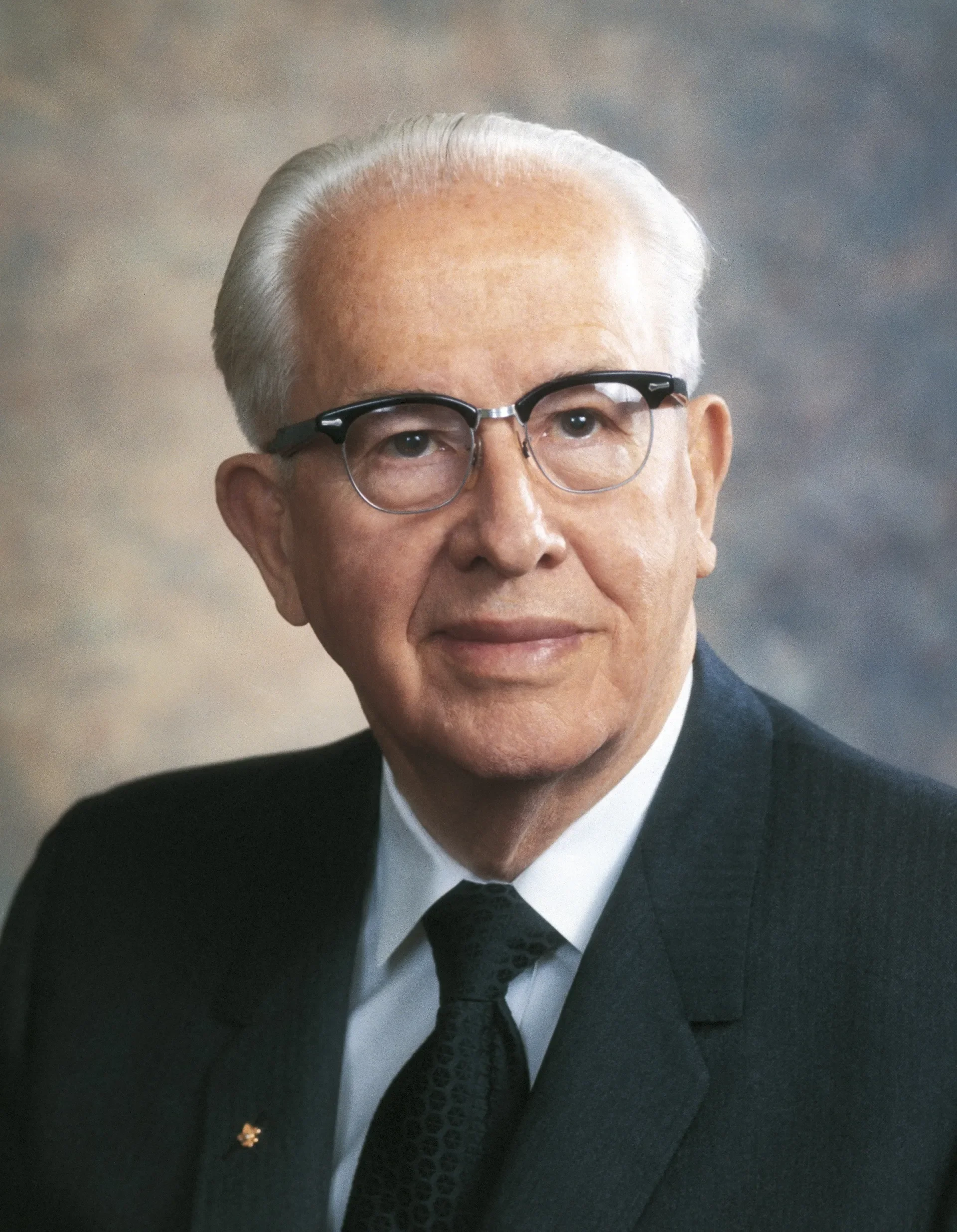
Official portrait of President Ezra Taft Benson. (Image sourced from churchofjesuschrist.org.)
President Benson gave four things we must do to support and defend the Constitution:
1. We must be righteous and moral. We must live the gospel principles—all of them. We have no right to expect a higher degree of morality from those who represent us than what we ourselves are.
2. We must learn the principles of the Constitution and then abide by its precepts. Have we read the Constitution and pondered it? Are we aware of its principles? Could we defend it? Can we recognize when a law is constitutionally unsound? The Church will not tell us how to do this, but we are admonished to do it. I quote Abraham Lincoln: “Let [the Constitution] be taught in schools, in seminaries, and in colleges; let it be written in primers, spelling-books, and in almanacs; let it be preached from the pulpit, proclaimed in legislative halls, and enforced in courts of justice. And, in short, let it become the political religion of the nation.”
3. We must become involved in civic affairs. As citizens of this republic, we cannot do our duty and be idle spectators. It is vital that we follow this counsel from the Lord: “Honest men and wise men should be sought for diligently, and good men and wise men ye should observe to uphold; otherwise whatsoever is less than these cometh of evil” (D&C 98:10). Note the qualities that the Lord demands in those who are to represent us. They must be good, wise, and honest. We must be concerted in our desires and efforts to see men and women represent us who possess all three of these qualities.
4. We must make our influence felt by our vote, our letters, and our advice. We must be wisely informed and let others know how we feel. We must take part in local precinct meetings and select delegates who will truly represent our feelings.
President Dallin H. Oaks has an additional responsibility as an Apostle of Jesus Christ to apply the Constitution to the work of the Lord in the latter days. President Oak’s sermon entitled Defending Our Divinely Inspired Constitution, given at April 2021 General Conference, was the basis for the Fifth Sunday program, held on May 31, 2026 in Church units throughout the United States, commemorating the 250th anniversary of the signing of the Declaration of Independence. Significantly, President Oaks introduced his April 2021 General Conference sermon by outlining his qualifications to teach the doctrine of the US Constitution:
“In these remarks I do not speak for any political party or other group. I speak for the United States Constitution, which I have studied for more than 60 years. I speak from my experience as a law clerk to the chief justice of the United States Supreme Court. I speak from my 15 years as a professor of law and my 3½ years as a justice on the Utah Supreme Court. Most important, I speak from 37 years as an Apostle of Jesus Christ, responsible to study the meaning of the divinely inspired United States Constitution to the work of His restored Church” (emphasis added). Now as President of the Church of Jesus Christ of Latter-day Saints, President Oaks is in the unique position to teach what the Lord wants us to understand about the Constitution.
President Oaks has spoken often about our divinely inspired Constitution. Examples follow:
In 2012 President Oaks told me personally that “the greatest challenge to the Church in fulfilling its mission to take the gospel to the world is the increasing effort in many nations, including the United States, to limit religious freedom” (in a conversation after a Salt Lake Temple Devotional while I was serving in the temple presidency)
In his sermon Love Your Enemies President Oaks spoke of “Constitutional Patriotism”. President Oaks taught, “the key is constitutional patriotism. We have to remain united by and through the Constitution, regardless of our ideological disagreements” Addressing the riots in the United States in the summer of 2020, and what turned out to be prophetic concerning the riot at the Capital in Washington DC on January 6, 2021, he continued: “the Constitution protects peaceful protests. Protesters have no right to destroy, deface, or steal property or to undermine the government’s legitimate police powers. The Constitution and laws contain no invitation to revolution or anarchy….Abraham Lincoln was right when he said, “There is no grievance that is a fit object of redress by mob law.” Redress of grievances by mobs is redress by illegal means. That is anarchy, a condition that has no effective governance and no formal police, which undermines rather than protects individual rights. (General Conference, October 2020).
Defending Our Divinely Inspired Constitution. In this landmark sermon given in April 2021 General Conference President Oaks continued to teach the Constitution, and he identified the following five divinely inspired principles. (Following each principle I have added a brief personal observation which are in brackets and italicized)
“First is the principle that the source of government power is the people. In a time when sovereign power was universally assumed to come from the divine right of kings or from military power, attributing sovereign power to the people was revolutionary. Philosophers had advocated this, but the United States Constitution was the first to apply it. Sovereign power in the people does not mean that mobs or other groups of people can intervene to intimidate or force government action. The Constitution established a constitutional democratic republic, where the people exercise their power through their elected representatives.” (Today sovereign power in the people is threatened by the executive branch that claims unprecedented powers)
“A second inspired principle is the division of delegated power between the nation and its subsidiary states. Significantly, the United States Constitution limits the national government to the exercise of powers granted expressly or by implication, and it reserves all other government powers “to the States respectively, or to the people.” (Rather than the national government power being limited, today it is expanding rapidly)
“Another inspired principle is the separation of powers…The inspiration in the American convention was to delegate independent executive, legislative, and judicial powers so these three branches could exercise checks upon one another.” (Unfortunately, Congress has largely abdicated its responsibility in this regard)
A fourth inspired principle is in the cluster of vital guarantees of individual rights and specific limits on government authority in the Bill of Rights, adopted by amendment just three years after the Constitution went into force….Without a Bill of Rights, America could not have served as the host nation for the Restoration of the gospel, which began just three decades later. (We must continuously defend our freedom. It is the purpose of the Adversary to erode our freedoms)
Fifth and finally, I see divine inspiration in the vital purpose of the entire Constitution. We are to be governed by law and not by individuals, and our loyalty is to the Constitution and its principles and processes, not to any office holder. In this way, all persons are to be equal before the law. These principles block the autocratic ambitions that have corrupted democracy in some countries. They also mean that none of the three branches of government should be dominant over the others or prevent the others from performing their proper constitutional functions to check one another. (Some people’s primary loyalty is to a party or an office holder. Too often loyalty to an office holder is the primary consideration for high government appointments. Rather, it should be experience and competency)
The Church of Jesus Christ of Latter-day Saints does not tell its members what to think or how to vote. When asked how the Church is governed the Prophet Joseph Smith replied, “I teach them correct principles, and they govern themselves.” It is the same today. In his April 2021 sermon President Oaks said, “We teach correct principles and leave our members to choose how to prioritize and apply those principles on the issues presented from time to time.” (Hopefully, faithful members of the Church will give prayerful consideration to what their leaders teach)
Testimony. Because the Constitution is the work of the Lord, and because the work of the Lord does not fail (see D&C 3:1), I firmly believe in the concluding words of President Benson’s sermon entitled The Divinely Inspired Constitution discussed earlier. He said: “It is my conviction that when the Lord comes, the Stars and Stripes will be floating on the breeze over this people. May it be so, and may God give us the faith and the courage exhibited by those patriots who pledged their lives and fortunes that we might be free, in the name of Jesus Christ. Amen.”
Released on June 8th. 2026.