
Lessons of 2026
Lesson No. Forty-Four
Mount Rushmore Presidents - Abraham Lincoln
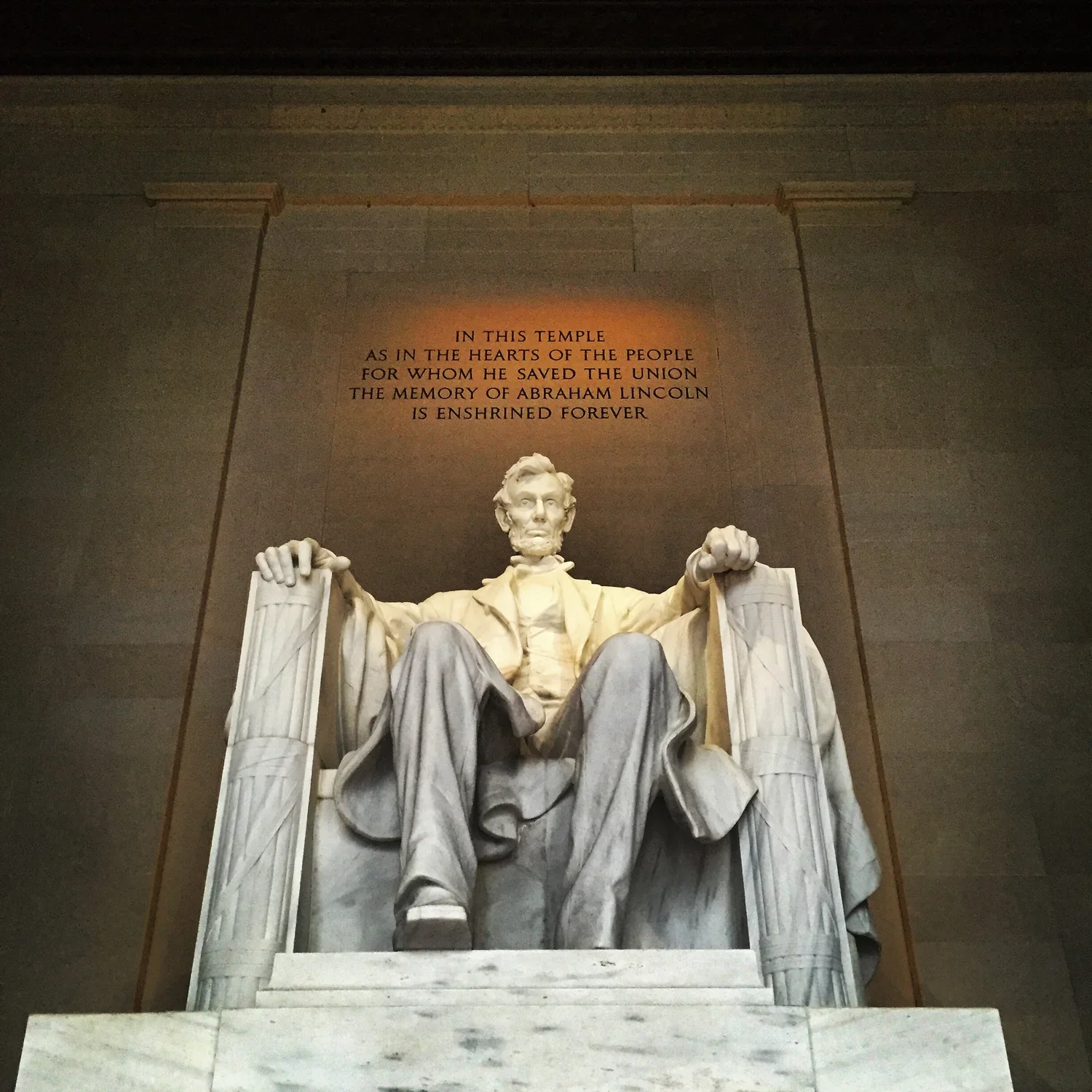
Photo of the Lincoln Memorial. (Image sourced from nationalmall.org.)
This week we celebrate Thanksgiving. As we do so it would be well to remember our dependence on the Lord and to be thankful for our blessings. Unfortunately, there is great effort to take God out of Thanksgiving and replace Him with Black Friday and shopping. We should make sure our children and grandchildren understand that prayer and gratitude to God is our historical reason for a national day of Thanksgiving.
Pilgrims. In November 1620 the Mayflower landed at Plymouth with 102 pilgrims on board. About half died of disease and harsh winter conditions during their first winter. Crops were planted in the Spring of 1621 and with the help of Native Americans there was a bounteous harvest. Being God-fearing people they held the first Thanksgiving celebration.
George Washington. In 1789, just a few years after the Revolutionary War, President George Washington called for an official celebratory “day of public thanksgiving and prayer.” Our county overwhelmingly agreed, but the tradition of a national holiday did not happen.
Abraham Lincoln issued Presidential Proclamations in 1863 and 1864 each calling for a national day of Thanksgiving. Each Proclamation emphasized the need for prayer and gratitude, and established a national day of Thanksgiving. The 1864 Proclamation concluded:
“Now, therefore, I, Abraham Lincoln, President of the United States, do hereby appoint and set apart the last Thursday in November next as a day which I desire to be observed by all my fellow-citizens, wherever they may then be, as a day of thanksgiving and praise to Almighty God, the beneficent Creator and Ruler of the Universe. And I do further recommend to my fellow-citizens aforesaid that on that occasion they do reverently humble themselves in the dust and from thence offer up penitent and fervent prayers and supplications to the Great Disposer of Events for a return of the inestimable blessings of peace, union, and harmony throughout the land which it has pleased Him to assign as a dwelling place for ourselves and for our posterity throughout all generations.”
Abraham Lincoln overcame his humble beginnings through education. He was self-taught becoming well educated. He studied geometry, literature, and Shakespeare. Local teachers taught him grammar and speech. He worked in general stores and learned merchandising. He was appointed postmaster. He learned surveying and was appointed deputy surveyor. He borrowed books and studied law, eventually becoming a respected lawyer. Education gave Lincoln the self-confidence he needed to enter politics.
Lincoln was self-confident. “That Lincoln after winning the presidency, made the unprecedented decision to incorporate his eminent rivals into his political family, the cabinet, was evidence of a profound self-confidence and a first inclination of what would prove to others a most unexpected greatness…Every member of this administration was better known, better educated, and more experienced in public life than Lincoln. Their presence in the cabinet might have threatened to eclipse the obscure prairie lawyer from Springfield.
“It soon became clear that Abraham Lincoln would emerge the undisputed captain of this most unusual cabinet, truly a team of rivals” (Doris Goodwin, Team of Rivals, p. xvi).
Lincoln was kind, sensitive, compassionate, honest, and empathetic. Lincoln was a student of the Bible, especially the New Testament. Lincoln’s speeches and writings show that he was a disciple of Jesus Christ. He often quoted or paraphrased Jesus’ teachings. He knew and lived what Jesus taught in the Sermon of the Mount. This gave Lincoln the confidence to function at the highest level, even during the worst days of the Civil War.
Lincoln was humble because he knew he had to rely on the Lord. He often spoke about the need to rely on the Lord. In his Second Inaugural Address, which many think is his greatest speech and given just a month before he was killed, he frequently used Biblical verses and theological language. He quoted from the Bible four times, mentioned God 14 times, and called for prayer three times.
Lincoln ends his Second Inaugural Address with a powerful application of Matthew 5:44: “With malice toward none with charity for all with firmness in the right as God gives us to see the right let us strive on to finish the work we are in to bind up the nation's wounds, to care for him who shall have borne the battle and for his widow and his orphan ~ to do all which may achieve and cherish a just and lasting peace among ourselves and with all nations."
Testimony. President Dallin H. Oaks has asked us all to be peacemakers and live the teachings of Jesus Christ. Lincoln is a great example of a man who did this.
A little known fact of Lincoln’s impact on our nation is that at the end of the war he instructed his generals: “When this war ends there must be no bloody work. There must be no hangings, there must be none of that”. Throughout history at the end of civil wars, there has been more bloodshed, more turmoil and hatred, often lasting for years. But instead Lincoln insisted on a benevolent peace. That our country avoided mass killing and great retribution at the end of the Civil War is a result of Lincoln’s belief in Jesus’ teaching to: “Love your enemies, bless them that curse you, do good to them that hate you, and pray for them which despitefully use you, and persecute you” (Matthew 5:44).
Postscript. In 1909, forty-four years after Lincolns death and with enough time having passed to accurately assess his impact, Leo Tolstoy wrote in The World, a New York newspaper the following: “The greatness of Napoleon, Caesar or Washington is only moonlight by the sun of Lincoln. His example is universal and will last thousands of years…He was bigger than his country – bigger than all the Presidents together…and as a great character he will live as long as the world lives”.
Released on November 26th. 2026.