
Lessons of 2025
Lesson No. Fifty
Two Questions for the New Year
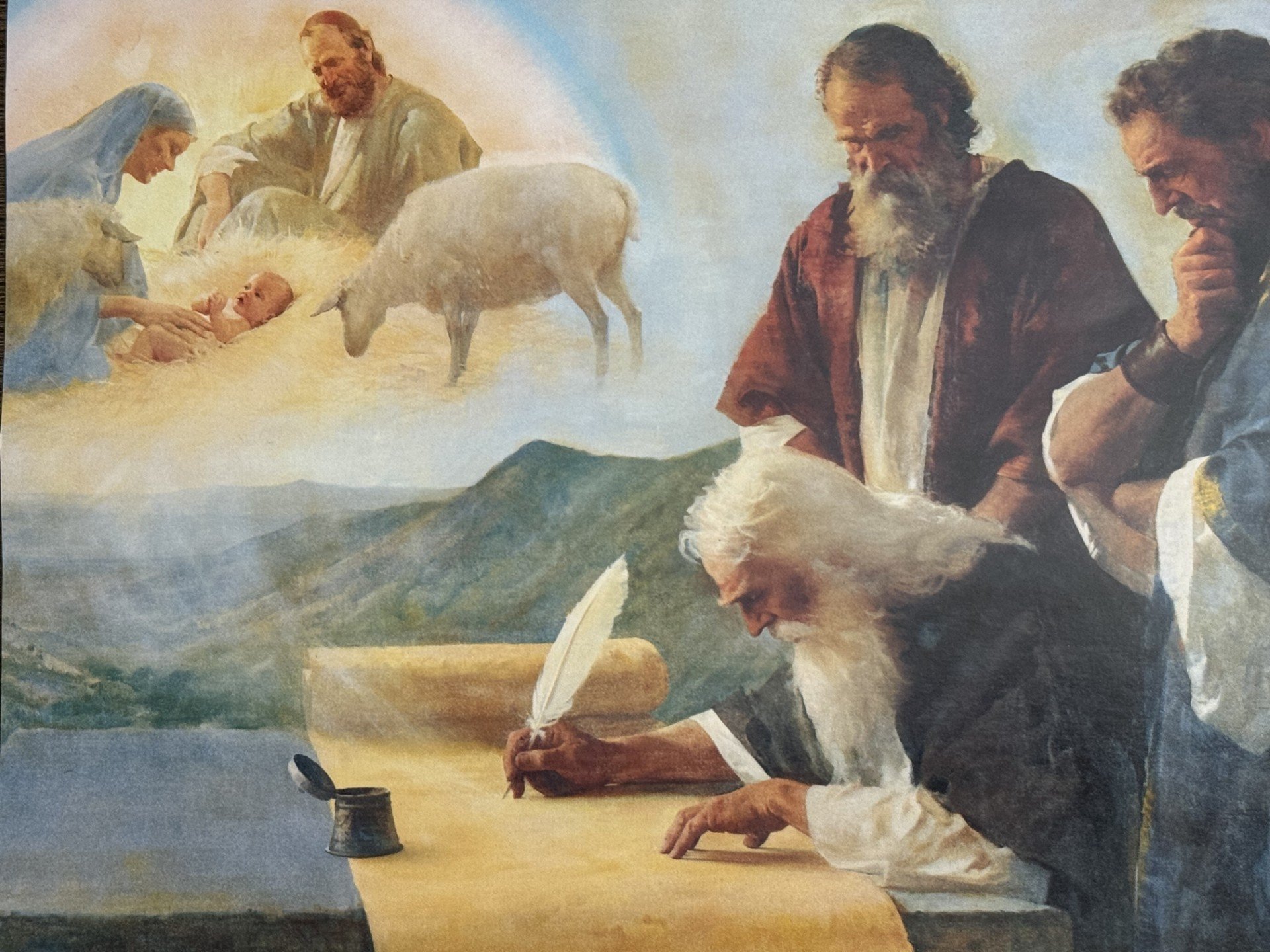
Painting depicting the prophesies of the birth of Jesus Christ the Prophet Isaiah had and wrote.
Introduction. After the destruction of the Nephite civilization, Moroni wrote to warn the people of the latter days not to follow the same course the Nephites did. He had a vision of the latter days and could say, “I know your doing” (Mormon 8:34-35). He warned us and asked rhetorical questions we should answer for ourselves. (See Mormon 8:23-41). As I have reviewed Moroni’s questions there are two questions I am going to ask myself frequently during 2026.
First question, “How am I doing regarding pride?” Moroni explained what he had seen in vision about the latter days saying, “And I know that ye do walk in the pride of your hearts; and there are none save a few only who do not lift themselves up in the pride of their hearts….unto envying, and strifes, and malice, and persecutions, and all manner of iniquities” (Mormon 8:35-36).
I remember well President Ezra Taft Benson’s landmark sermon entitled, Beware of Pride, given at April 1989 general conference. I was called as the president of the Louisville Kentucky Mission a year later, and I often read and thought about this sermon during that time. It had a great impact on me, and I am going to start reading it again. I highly recommend it.
President Benson said: “Pride affects all of us at various times and in various degrees…Pride is the universal sin, the great vice” (Ibid) We may feel like Benjamin Franklin who as a young printer age 27 launched a plan to attain what he called “moral perfection.” First he made a list of twelve virtues he thought desirable, and to each he appended a short definition: Temperance, Silence, Order, Resolution, Frugality, Industry, Sincerity, Justice, Moderation, Cleanliness, Tranquility, and Chastity.
He recalled this effort at age 79 when he wrote of it in his Autobiography. A Quaker friend “kindly” informed him that he had left something off: Franklin was often guilty of “pride,” the friend said, citing many examples, showing he could be “overbearing and rather insolent.” So Franklin added “humility” to be the thirteenth virtue on his list with the short definition of “Imitate Jesus and Socrates.”
In describing his effort to attain humility Franklin, humorously and with great insight, wrote: “There is perhaps not one of our natural passions so hard to subdue as pride; disguise it, struggle with it, beat it down, stifle it, mortify it as much as one pleases, it is still alive and will every now and then peep out and show itself. You will see it perhaps often in this history. For even if I could conceive that I had completely overcome it, I would probably be proud of my humility.”
“Pride is a switch that turns off priesthood power. Humility is a switch that turns it on….Every mortal has at least a casual if not intimate relationship with the sin of pride. No one has avoided it; few overcome it…. (Pride and the Priesthood, Dieter F. Uchtdorf, general conference Oct. 2010).
“The antidote for pride is humility—meekness, submissiveness” (Beware of Pride, Ibid). We should strive to emulate Jesus’ perfect example of humility, meekness, and submissiveness. There are others whose example we can learn from. One of these was George Washington. David McCullough wrote what Abigail Adams said about Washington being modest, wise, and good:
“In my view, one of the most astute of all observers of George Washington, one of the most astute observers of that whole period of our nations life, and one of the wisest of all Americans ever was Abigail Adams, wife of John Adams. And what she wrote about George Washington is as perceptive as almost anything to be found. Here’s some of what she said: “He is polite with dignity, affable without familiarity, distant without haughtiness, grave without austerity, modest, wise , and good” (David McCullough, History Matters, p. 72).
The second question I am going to ask myself is, “Does it have life? One of the questions Moroni asks people of our day is: “Why do ye adorn yourselves with that which hath no life, and yet suffer the hungry, and the needy, and the naked, and the sick and the afflicted to pass by you, and notice them not?” (Mormon 8:39).
We learn from Moroni that things which have no life do not have the same eternal value as things that have life. The works of God have life, and because He is eternal His works are eternal also. A man and a woman can bring a new born child into the world. But it is the spirit that gives life to the child’s mortal body, and the spirit comes from God. This principle applies all living things. Mortal man by himself cannot create life, not in a test tube, or in a laboratory, or in a workshop, or anywhere else. Life is a gift of God, and eternal life “is the greatest of all the gifts of God” (1 Nephi 15:36).
Things that have no life are man-made and temporary, and includes every man-made possession. Moroni observes that people in the latter days will adorn themselves with things which have no life such as clothing and jewelry. In our world material possessions, things which have no life, often take precedence over people who are hungry, and needy, and naked, and sick, and afflicted. (See Mormon 8:39)
One of the ways to tell the value of something is to ask, “When I share it is it increased or decreased? – Things of a temporal or mortal nature when shared are diminished and divided. For example, if we have a dollar and divide it in half then we will have fifty cents. The same can be said of all material things. If we divide them we will have less. This isn’t necessarily negative because often we fill our lives with more material things than we need or can use. By sharing we bless ourselves and others.
The gifts of God are of an eternal nature, and when we share them we have more. As we share our love our capacity to love is increased, and we have more to share the next time. This is true of all spiritual virtues. If we share our faith by bearing testimony, our faith and our testimony is increased. If we are kind, others usually will reciprocate, and kindness is increased all around. Lighting someone else’s candle of knowledge does not decrease our candle but it increases light in the entire house .
Testimony. If we make people more important than material things, and if we develop and share things of an eternal nature, we will then be prepared to live where all things are eternal.
Released on December 28th. 2025.